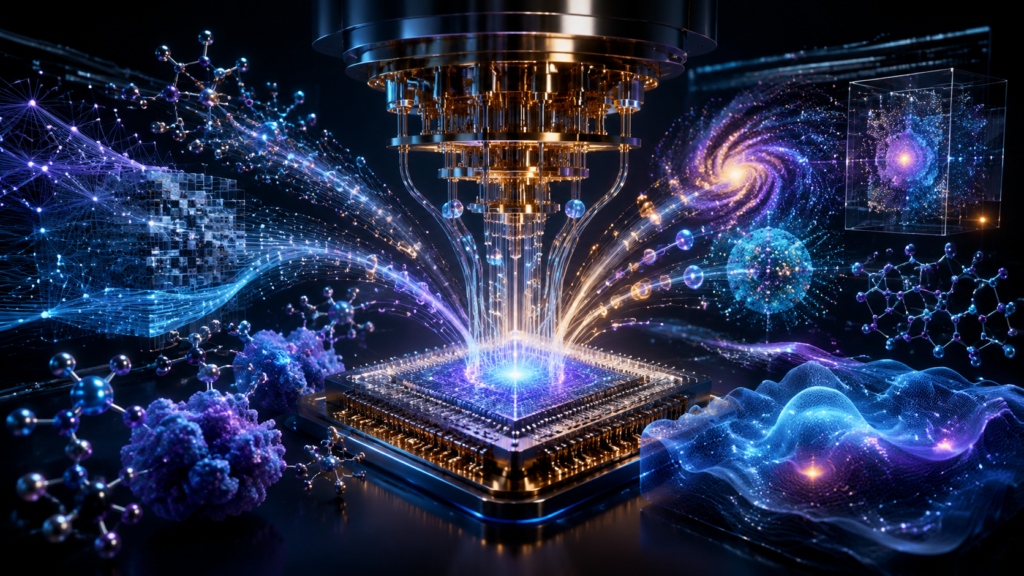
Two transformative technologies are beginning to converge, but evidence matters more than expectation
Generative Artificial Intelligence has changed how people search for information, write software, analyse data and generate scientific hypotheses. Quantum computing is developing along a different path, using qubits, interference and entanglement to represent and manipulate certain computational problems in ways that are not available to conventional computers. Their convergence is often described as Quantum AI, Quantum Machine Learning, or quantum enhanced generative modelling. The field is scientifically promising, but it is also vulnerable to exaggerated claims. The important research question is not whether quantum computers will suddenly replace present AI infrastructure. It is whether carefully selected quantum operations can produce a measurable advantage inside a larger classical AI workflow.
The scale of the two fields is very different. Generative AI is already a widely deployed general purpose technology. The Stanford AI Index Report 2026 states that organisational AI adoption reached 88 per cent in 2025, while industry produced more than 90 per cent of notable frontier models. Quantum computing, by comparison, remains predominantly a research and engineering platform. Its commercial importance is growing, but large scale, fault tolerant systems are still under development. The intersection should therefore be understood as an emerging research programme, not as a mature replacement for GPUs, conventional supercomputers, or established machine learning methods.1
Why are these technologies converging?
Modern generative models depend on repeated matrix operations, optimisation, sampling and the estimation of complex probability distributions. These operations require substantial computing capacity. The International Energy Agency reported that global data centres consumed approximately 485 terawatt hours of electricity in 2025 and projected consumption of about 950 terawatt hours by 2030, representing nearly 3 per cent of global electricity demand. Electricity consumption associated with AI focused data centres is projected to triple during the same period. These figures do not prove that quantum computing will reduce the environmental cost of AI, but they explain why researchers are investigating alternative computing architectures instead of assuming that conventional model scaling can continue indefinitely.2
Quantum computing should not be described merely as faster computing. A quantum processor does not accelerate every task, and many ordinary calculations remain better suited to conventional hardware. Its potential value arises when a problem has mathematical structure that a quantum algorithm can exploit. Candidate areas include sampling from complicated distributions, simulating quantum systems, solving selected optimisation problems and processing data that are quantum in origin. The practical objective is consequently selective acceleration. A quantum processor may become one specialised component alongside central processing units, graphics processing units, high performance computing clusters and classical machine learning systems.
The future of Quantum AI is more likely to be modular than revolutionary. A useful system may contain a classical generative model for language or design, a quantum processor for one narrowly defined simulation or sampling task, and a classical verification system that checks the result. The value of the quantum component must be measured against the total cost of data preparation, circuit execution, error mitigation, communication and classical post-processing.
The relationship runs in two directions
Quantum computing for artificial intelligence
Researchers are investigating whether quantum algorithms can improve particular components of machine learning rather than reproduce an entire large language model on quantum hardware. The principal research areas include quantum neural networks, quantum kernels, variational quantum circuits, Quantum Generative Adversarial Networks, Quantum Circuit Born Machines, Quantum Boltzmann Machines, Quantum Variational Autoencoders and quantum diffusion models. These architectures seek to learn or sample probability distributions by exploiting quantum states and measurement. Potential advantages may include compact representation, efficient sampling, or improved treatment of data generated by quantum physical systems. However, most experiments still use small datasets, limited circuits, simulations, or noisy processors, which makes direct comparison with mature classical systems difficult.
Recent evidence illustrates both the promise and the limitation. A 2026 large scale statistical study compared 460 quantum neural networks using 11 to 13 qubits with 4,480 classical neural network architectures. The quantum models achieved comparable accuracy and showed possible advantages in data scarce settings, but this was not a demonstration that quantum models universally outperform classical learning. Similarly, the 2026 MNISQ dataset study reported quantum kernel accuracy of up to 97 per cent in multiclass circuit classification. Such results are useful research signals, but a high accuracy percentage on a selected benchmark does not by itself establish lower cost, better generalisation, superior scalability, or commercial quantum advantage.34
Artificial intelligence for quantum computing
The reverse direction may generate practical value sooner. Quantum devices are difficult to design, calibrate and control because their behaviour is affected by noise, imperfect gates, limited connectivity and interactions with the surrounding environment. A major 2025 review in Nature Communications examined the use of artificial intelligence across quantum computing. It identified applications in device design, hardware control, calibration, state preparation, state characterisation, error correction, circuit optimisation and the discovery of quantum experiments. Generative models can also search large spaces of circuit structures, experimental configurations and quantum states. In this role, AI does not wait for a powerful fault tolerant quantum computer. It assists researchers in improving the quantum systems that already exist.5
Why hybrid computing is the realistic near-term model
A hybrid quantum and classical workflow divides a computational problem into parts. Conventional processors perform data preparation, model training, orchestration and post-processing, while the quantum processor performs a selected circuit or simulation. The output returns to the classical system, which updates parameters or verifies the result. This arrangement is already common in variational quantum algorithms, where a classical optimiser repeatedly changes the parameters of a quantum circuit. It is also consistent with the concept of quantum centric supercomputing, under which quantum hardware is integrated with CPUs, GPUs, high speed networks and shared storage rather than operated as an isolated machine.
IBM’s published roadmap illustrates the direction of industrial research but should be read as a target, not as independent proof of advantage. Its 2026 roadmap refers to circuits with 7,500 gates across as many as three 120 qubit modules and identifies 2029 as a target for a large scale fault tolerant system. Roadmaps are useful for understanding engineering priorities, particularly modular processors, error correction and integration with high performance computing. They do not establish that the planned systems will achieve a useful economic advantage on a specific machine learning task. Independent benchmarking will remain essential.6
A processor may demonstrate quantum advantage on a carefully designed computational problem without delivering practical advantage in a real research workflow. Data transfer, circuit preparation, repeated measurements, error mitigation, hardware access charges and classical verification may consume the theoretical gain. Claims should therefore be evaluated at the level of the complete workflow, not merely at the level of one quantum circuit.
How should a claim of quantum advantage be tested?
Quantum AI research needs a clearer standard of evidence. The phrase quantum advantage is sometimes used for theoretical complexity results, favourable simulations, performance on physical hardware and commercial usefulness, even though these are different achievements. A research paper can demonstrate that an algorithm has desirable mathematical properties without showing that a present device can execute it efficiently. Likewise, a small hardware experiment can outperform one classical baseline while remaining inferior to stronger classical algorithms. A responsible evaluation should move through the following five levels and identify exactly which level has been reached.
- Theoretical advantage: A mathematically stated improvement exists under clearly identified assumptions.
- Simulation advantage: The quantum model performs favourably in an ideal or noise model simulation.
- Hardware advantage: The result is reproduced on a physical quantum processor under realistic noise.
- Workflow advantage: The full hybrid process outperforms the best relevant classical method after all overheads are included.
- Economic or scientific advantage: The system reduces cost, time, energy, or experimental effort, or enables a result that was previously inaccessible.
This distinction is supported by the weaknesses found in existing literature. A 2025 systematic review of quantum machine learning in digital health examined 16 studies and reported that 14 compared hardware results with ideal simulations without adequate characterisation of noise. Only two used noise simulations, and even those employed limited models. The review concluded that stronger comparisons, realistic noise analysis and better reporting are necessary before reliable claims can be made about clinical advantage. Although the review concerned healthcare, its methodological warning applies across Quantum AI research.7
The principal scientific limitations
Noise and error correction
Qubits are highly sensitive to their environment. Imperfect gates, measurement errors and decoherence can corrupt a computation before it produces a useful result. Error mitigation can improve selected calculations, but large scale reliable computing ultimately requires quantum error correction, in which many physical qubits may be needed to create one dependable logical qubit. This requirement explains why a device’s advertised physical qubit count is not a sufficient measure of practical capability. Circuit depth, gate fidelity, connectivity, coherence time, logical error rate and the quality of classical control are equally important.
Data loading and readout
Many machine learning applications begin with classical data. Encoding a large classical dataset into quantum states may itself require substantial time and circuit depth. At the other end of the process, quantum measurements return limited classical information, so repeated circuit execution may be necessary to estimate an output accurately. A theoretical speed improvement inside the quantum calculation can disappear when these input and output costs are considered. Quantum learning may therefore be more naturally suited to quantum generated data, compact structured datasets, or problems where the encoding process is itself efficient.
Training instability and barren plateaus
Variational quantum circuits are commonly trained by a classical optimiser, but their gradients may become extremely small as the circuit grows. This problem, known as a barren plateau, can make useful parameter updates difficult. Researchers are examining circuit design, local cost functions, parameter initialisation, layerwise training and problem specific structures as possible responses. The issue shows why theoretical expressivity is not enough. A model may be capable of representing a solution but still be practically untrainable.
Weak or incomplete classical baselines
A quantum model can appear successful when it is compared only with a basic classical algorithm. A meaningful study should include well-tuned classical neural networks, kernel methods, tensor networks, probabilistic models and problem specific heuristics where relevant. It should also report the computational budget, number of parameters, training samples, energy use, number of circuit executions and uncertainty across repeated trials. Without these controls, it is difficult to determine whether an observed improvement comes from quantum computation, model architecture, data preprocessing, or an uneven comparison.
Where could quantum generative AI create value?
| Research area | Possible combined workflow | Present evidence | Readiness |
|---|---|---|---|
| Drug discovery | Generative AI proposes molecules while quantum simulation evaluates selected electronic properties. | Strong scientific rationale, but large scale practical advantage remains unproven. | Active research |
| Materials science | AI generates structures and synthesis candidates while quantum methods study difficult molecular interactions. | Promising because molecular behaviour is quantum mechanical, but present hardware limits system size. | Emerging |
| Optimisation | AI interprets constraints and quantum algorithms search selected solution spaces. | Many experiments exist, but results depend heavily on the problem and classical baseline. | Active research |
| Quantum hardware control | AI predicts noise, calibrates devices, selects circuits and assists error correction. | Relevant to existing devices and may produce value before fault tolerant computing. | Nearer term |
| Generative data modelling | Quantum circuits learn or sample complex probability distributions within a classical model. | Encouraging small scale results, but generalisation and scalability remain open questions. | Early stage |
| Climate and energy | Hybrid systems support materials discovery, grid optimisation and complex physical modelling. | Potentially valuable, but most claimed applications remain prospective. | Early stage |
Drug discovery and materials research
Molecules and materials are natural areas of interest because their electronic behaviour is governed by quantum mechanics. Generative AI can propose molecular structures, proteins, catalysts, battery materials, semiconductors or synthesis routes. A quantum processor may eventually calculate selected properties that are difficult to approximate classically. The most credible workflow is a feedback loop: AI generates candidates, classical methods eliminate unsuitable options, quantum simulation evaluates a small number of difficult cases, experiments validate the strongest candidates, and the resulting data improve the generative model. The value comes from reducing the search space, not from expecting one machine to perform every stage.
Rare events and scientific sampling
Generative models are often required to represent events that occur infrequently but have serious consequences, such as extreme market movements, unusual molecular configurations, equipment failure or severe weather conditions. Quantum generative models are being studied for their ability to represent and sample complicated probability distributions. This is a potentially important direction, but it requires particularly careful validation because a model can reproduce common patterns while failing in the distribution tails. Researchers should assess tail recall, calibration, diversity, mode collapse and performance on unseen data rather than relying only on average accuracy.
AI assisted quantum experimentation
AI can search possible quantum circuits, recommend experimental parameters, detect unusual measurements and help reconstruct quantum states from incomplete observations. This may shorten the cycle between hypothesis, experiment and correction. Generative systems may also propose circuit structures or laboratory configurations that a researcher would not readily identify. Human verification remains indispensable because a generated circuit can be syntactically valid while being physically impractical, excessively noisy, or scientifically irrelevant.
Will quantum computing solve AI’s energy problem?
It is too early to answer affirmatively. The International Energy Agency recorded a 17 per cent increase in data centre electricity consumption during 2025, while global electricity demand grew by approximately 3 per cent. This establishes the urgency of improving computational efficiency, but it does not establish that quantum computing is the solution. Quantum systems may require cryogenic cooling, precision control electronics and substantial classical computing support. Their total energy use must be evaluated at system level. A fair comparison should measure energy per useful, verified result, including repeated circuit execution, cooling, data movement, error mitigation and classical post-processing.8
The more defensible near-term strategy is to pursue efficiency across the entire computing stack. Researchers can use smaller specialised models, efficient numerical methods, improved chips, better data centre design, low carbon electricity and carefully chosen quantum components where evidence supports them. Quantum computing may eventually reduce the cost of specific calculations, especially in simulation and optimisation, but describing it as a general solution to AI energy demand would go beyond current evidence.
Why the convergence matters for India
India has established substantial public programmes in both fields. The National Quantum Mission was approved with an outlay of ₹6,003.65 crore for the period from 2023 to 2031. Its objectives include quantum computing, communication, sensing, materials and the creation of a national research ecosystem. A 2025 call issued under the Mission specifically included AI and machine learning integration with quantum technologies and hybrid quantum and high performance computing systems among its priority areas. This provides an institutional basis for Indian universities to develop interdisciplinary projects rather than treating AI and quantum science as unrelated subjects.9
India is also expanding access to conventional AI infrastructure. Government information published in August 2026 reported that more than 45,000 GPUs had been made available under the IndiaAI shared compute framework by June 2026. It further stated that 237 projects had received subsidised compute support covering 93.18 lakh GPU hours. This infrastructure does not directly provide quantum capability, but it can support simulation, hybrid algorithm development, benchmarking and AI based quantum control. Universities should connect these resources with the National Quantum Mission, national supercomputing facilities and institutional laboratories to create reproducible hybrid research programmes.10
Indian universities do not need to wait for a domestic fault tolerant quantum computer before beginning meaningful work. They can develop quantum algorithms in simulation, test limited circuits through cloud hardware, build classical baselines on shared GPU infrastructure, study quantum control with AI, and create sector specific datasets for agriculture, pharmaceuticals, materials, energy and logistics. The strongest projects will state a narrow problem, establish a competitive classical benchmark and explain why a quantum component is scientifically justified.
A research agenda for universities and young researchers
The convergence offers opportunities across computer science, physics, mathematics, chemistry, pharmaceutical science, engineering, law and public policy. Computer scientists can study hybrid algorithms, quantum kernels, generative circuits and benchmarking. Physicists can work on hardware, noise, control and error correction. Mathematicians can investigate complexity, optimisation and the geometry of quantum models. Chemists and pharmaceutical researchers can test quantum assisted molecular workflows, while engineering researchers can examine materials, energy systems and industrial optimisation. Meaningful projects should be interdisciplinary from the beginning because a technically impressive algorithm may have little value if it is detached from a genuine scientific problem.
A university entering this field should avoid beginning with the broad objective of building a better quantum AI system. It should select a defined research question, such as whether a particular variational circuit improves sampling for a small molecular dataset under a fixed computational budget. The project should preregister evaluation criteria, compare several classical baselines, test both simulated and real noise, disclose hardware and software versions, repeat experiments and publish negative results. Such methods would produce more reliable knowledge than demonstrations designed mainly to generate publicity.
- Develop benchmark datasets that reflect Indian scientific and industrial problems.
- Compare quantum, quantum inspired and classical methods under the same resource budget.
- Study AI based calibration, control and error mitigation for quantum hardware.
- Investigate compact generative models for molecular and materials research.
- Measure total workflow time, cost and energy rather than circuit execution alone.
- Create interdisciplinary courses combining linear algebra, probability, quantum information, machine learning and research ethics.
- Build open repositories containing code, circuit descriptions, noise models and failed experiments.
- Examine the legal and policy implications of access, security, accountability and intellectual property.
The legal, ethical and policy questions
Quantum AI raises issues that extend beyond computing performance. Access to advanced hardware may be concentrated among a small number of governments, universities and technology companies. This can affect research independence, scientific equality and control over strategically important infrastructure. AI generated quantum circuits and scientific hypotheses may also create difficult questions concerning inventorship, authorship, ownership and responsibility. If an automated system proposes a molecule or experimental configuration that later causes harm, accountability may be distributed among model developers, hardware providers, researchers and institutions.
Cybersecurity requires particular attention. Large fault tolerant quantum computers could threaten widely used public key cryptographic systems, while generative AI may assist both defensive migration and hostile discovery of vulnerable systems. Organisations should not wait for cryptographically relevant quantum computers before identifying sensitive data, mapping cryptographic dependencies and planning migration to post quantum standards. India released a national task force report on implementing a quantum safe ecosystem in February 2026, reflecting the policy importance of early preparation.11
Governments are already treating quantum technology as a strategic field. The OECD reported in January 2026 that 18 OECD countries and the European Union had adopted dedicated national quantum strategies by November 2025, while governments worldwide had announced approximately USD 55.7 billion in public support since 2013. Yet organisational readiness remains limited. An OECD review published in March 2026 cited a survey in which only 20 per cent of respondents reported formal plans for quantum readiness. Another survey of quantum experts and decision makers identified technology immaturity as the leading adoption barrier, selected by 82 per cent of respondents. These findings reveal a persistent gap between strategic expectation and operational preparedness.1213
From generated content to generated scientific discovery
The most significant possibility is not simply faster computation. Generative AI is changing computers from systems that calculate predetermined outputs into systems that can propose hypotheses, molecular structures, algorithms, experimental designs and explanations. Quantum computing may eventually expand the range of physical systems and probability spaces that such tools can examine. A future research platform could read scientific literature, identify an unresolved question, generate candidate explanations, design molecules or materials, select experiments, run quantum and classical simulations, analyse results and recommend the next experiment.
Researchers would remain responsible for defining the problem, examining assumptions, verifying evidence and judging scientific significance. The system could nevertheless increase the number of hypotheses that can be investigated within a limited period. This transition from content generation to scientific discovery is more consequential than using generative AI merely to produce text or images. It also creates a higher standard of responsibility because an incorrect scientific recommendation may affect laboratories, patients, infrastructure or public policy.
The road ahead
Quantum AI is neither an empty promise nor an established revolution. It is a high potential research field in which the decisive evidence has not yet been produced. Generative AI already has large scale adoption and rapidly increasing infrastructure demands. Quantum computing has achieved important advances in hardware, algorithms and error correction, but practical fault tolerant systems remain under development. The strongest near-term opportunities lie in AI assisted quantum engineering, hybrid experimental workflows, quantum simulation and narrowly defined learning problems where data structure provides a credible reason for quantum computation.
The next breakthrough is unlikely to come from placing an entire large language model on a quantum computer. It is more likely to arise when researchers identify one difficult component of a scientific workflow, demonstrate that a quantum method improves it under realistic conditions, and integrate that method with classical computing and human verification. Progress should be judged through reproducible benchmarks, competitive classical comparisons and total system costs. If those standards are maintained, the convergence of Generative AI and quantum computing may develop from an attractive theoretical possibility into an important platform for scientific discovery.
Reports and research sources
- Stanford Institute for Human-Centered Artificial Intelligence, The 2026 AI Index Report, Stanford University, 2026.
- International Energy Agency, Key Questions on Energy and AI: Executive Summary, IEA, 2026.
- F. Ghisoni and others, A Large Scale Statistical Analysis of Quantum and Classical Neural Networks, Scientific Reports, 2026.
- L. Placidi and others, MNISQ: A Large-Scale Quantum Circuit Dataset for Machine Learning, Scientific Data, 2026.
- Y. Alexeev and others, Artificial Intelligence for Quantum Computing, Nature Communications, 2025.
- IBM, IBM Quantum Development and Innovation Roadmap, updated 2026.
- R. S. Gupta and others, A Systematic Review of Quantum Machine Learning for Digital Health, npj Digital Medicine, 2025.
- International Energy Agency, Data Centre Electricity Use Surged in 2025, IEA, 16 April 2026.
- Department of Science and Technology, Government of India, National Quantum Mission, updated 21 May 2026.
- Press Information Bureau, Government of India, Government Expands Sovereign AI Infrastructure Through the IndiaAI Mission, 6 August 2026.
- Department of Science and Technology, Government of India, Implementation of Quantum Safe Ecosystem in India, Task Force Report, 4 February 2026.
- Organisation for Economic Co-operation and Development, Quantum Technologies and the Role of Governments and Policy, OECD, 12 January 2026.
- Organisation for Economic Co-operation and Development, Building Business Readiness for Quantum Computing, OECD, 23 March 2026.