Can Low Cost Ceramic Filters Deliver Safe Drinking Water
Introduction
Access to safe drinking water remains one of the most important requirements of public health, environmental protection and sustainable development. Low-cost ceramic water filters offer a potentially attractive household treatment option because they can be manufactured from relatively accessible materials, operate through gravity and function without a continuous electricity supply. Nevertheless, the central engineering question is not whether a ceramic filter can make water appear cleaner. It is whether a specific product can reliably reduce the contaminants present in a particular water source to acceptable levels throughout its intended service life.
The international scale of the challenge demonstrates why affordable treatment technologies continue to attract research attention. According to the World Health Organization and UNICEF Joint Monitoring Programme, approximately 2.1 billion people lacked safely managed drinking-water services in 2024. The same assessment distinguishes basic access from safely managed services, which require an improved water source located on premises, available when needed and free from contamination. This distinction is essential because physical access to a water source does not necessarily establish microbiological or chemical safety. Household treatment may provide an additional protective measure where reliable centralised services are unavailable, but it should not be confused with the broader institutional responsibility to provide safe water. [1]
People lacking safely managed drinking-water services in 2024, according to the 2025 WHO and UNICEF monitoring report. [1]
Peer-reviewed household treatment studies included in a published systematic review covering research from 1997 to 2021. [2]
Filter performance, source-water quality, maintenance and safe storage must be assessed together.
A ceramic filter is commonly formed from clay mixed with a combustible or removable pore-forming material. During firing, the material develops interconnected pores through which water can move. Suspended particles and certain microorganisms may be retained by the porous structure. Filter dimensions, pore-size distribution, firing conditions and structural integrity determine how effectively the device performs. Manufacturing variations can therefore produce substantial differences between filters that appear identical to a household user. Additional antimicrobial substances or adsorbents may improve particular functions, but those improvements cannot be presumed without independent testing.
The appeal of locally manufactured systems extends beyond filtration. Local production may create employment, encourage technical training, reduce dependence on specialised imported equipment and support decentralised maintenance networks. These advantages, however, remain potential benefits rather than automatically established outcomes. Kiln energy requirements, production rejects, transport damage, replacement frequency and quality-control expenditure can change the economic and environmental balance considerably. A technically weak filter may also create a harmful sense of security if households believe that all dangerous substances have been removed.
The appropriate research problem is therefore multidimensional. It involves engineering design, public-health microbiology, analytical chemistry, manufacturing science, household behaviour, regulatory compliance and economic assessment. A convincing evaluation must demonstrate not only contaminant reduction under controlled conditions but also reproducibility across manufacturing batches, practical output capacity, resistance to deterioration and sustained correct use. The relevant comparison is not simply between filtered and visibly unfiltered water. It is between the ceramic system and the best feasible alternatives for a defined community and source-water condition.
How Ceramic Filtration Works
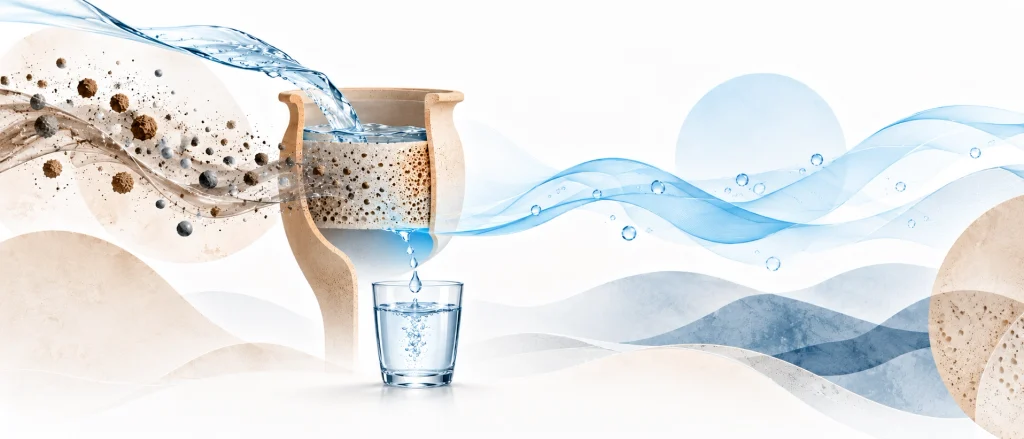
Ceramic filtration is a physical separation process in which water passes through a rigid porous medium. Most household ceramic filters use gravity as the driving force, although other designs may operate under pressure. Water enters the ceramic body, travels through its connected pore network and exits into a receiving vessel. Particles larger than accessible pore openings may be retained, while additional retention can occur through interception, deposition and interactions between microorganisms and the material surface. The contribution of each mechanism depends upon water chemistry, flow conditions, the structure of the filter and the properties of the contaminant.
Porosity, pore size and permeability
Three concepts are particularly important in filter engineering: total porosity, pore-size distribution and permeability. Porosity describes the fraction of the ceramic volume occupied by voids. Pore-size distribution describes the range and relative abundance of those openings, while permeability reflects how easily water travels through the connected structure. These properties are related but not interchangeable. Two ceramic samples may possess similar total porosity but perform very differently because one contains many small connected channels and the other contains fewer large passages.
The distinction between nominal and absolute pore-size ratings also matters. CDC guidance explains that a nominal or mean rating does not guarantee that every pore is below the stated dimension. Consequently, a material characterised by its average pore size cannot automatically be treated as an absolute barrier against microorganisms exceeding that average. Cracks, imperfect seals and bypass pathways may further weaken the connection between laboratory material measurements and actual filter performance. [3]
Flow and contaminant removal
Higher porosity and larger connected pores can increase water production, but may also reduce the retention of fine particles and microorganisms. Conversely, a denser ceramic may provide stronger physical restriction while producing water too slowly for ordinary household needs. This is a fundamental engineering trade-off, not a defect that can necessarily be eliminated by changing one ingredient. The appropriate design must balance the intended contaminant barrier with a flow rate that users can reasonably accept.
Flow measurements need standardised starting water levels, temperature conditions, sample preparation and collection periods because the hydraulic pressure within a gravity filter changes as the upper reservoir empties. A product that performs satisfactorily when completely filled may produce progressively less water during an ordinary household cycle. Reporting only the maximum initial flow can therefore exaggerate practical capacity. A defensible study reports average production over a representative operating cycle and records changes after repeated use.
Structural integrity and mechanical behaviour
Unlike flexible membrane filters, porous ceramic structures can be brittle. Mechanical loading during manufacture, transport, installation, washing or accidental impact may create visible or microscopic defects. A fracture can provide a preferential water pathway that undermines the intended treatment function. Accordingly, bending strength, handling durability, leak tightness and damage detection deserve the same systematic consideration as filtration rate. A filter should not be declared satisfactory solely because one intact laboratory specimen demonstrates effective contaminant reduction.
What the Scientific Evidence Shows
Scientific literature supports the potential value of ceramic filtration, but also demonstrates why performance claims must remain product-specific. A systematic review by Rao and colleagues, published in Environmental Science & Technology in 2025, examined 396 peer-reviewed studies of household water treatment technologies. The review covered porous ceramics, membrane systems, granular filtration, thermal treatment, ultraviolet systems, chemical disinfection and combined treatment methods. It found wide variation in reported microbial log-reduction values both between technologies and within individual technology categories. [2]
The review reported particularly strong protozoan removal findings for porous ceramic treatment relative to other eligible technology categories in its analysis, with a reported log-reduction value of approximately three for the relevant comparison. Importantly, this was a synthesis of study results, not a performance certification for every ceramic filter. Differences in design, testing protocols, challenge organisms, source-water properties and field conditions restrict the extent to which the result can be generalised. The study also emphasised that correct and sustainable use determines whether laboratory microbiological performance produces meaningful protection. [2]
Evidence from a controlled household trial
An important earlier investigation was conducted by Joe Brown, Mark D. Sobsey and Dana Loomis in rural Cambodia. Published in the American Journal of Tropical Medicine and Hygiene in 2008, the randomised controlled trial allocated households among a conventional ceramic water purifier group, an iron-rich ceramic filter group and a control group. Each group initially contained 60 households, and the intervention was followed for 18 weeks after baseline observations. Both intervention groups reported lower diarrhoeal disease prevalence than the control group. [5]
The reported longitudinal prevalence ratios were 0.51 for the conventional ceramic purifier and 0.58 for the iron-rich alternative. These findings suggest a potentially important health benefit in the studied population. Nevertheless, the estimates arose from one specific setting, the observation period was limited and the findings should not be converted into a universal promise that ceramic filtration will halve diarrhoeal illness. Household behaviour, source-water contamination, sanitary conditions, study methods and maintenance practices all influence the interpretation and transferability of such results. [5]
Interpreting log-reduction values
Microbial filtration performance is commonly expressed as a logarithmic reduction value, or LRV. An LRV of one represents a tenfold reduction in the measured organism concentration, corresponding to approximately 90 per cent removal. An LRV of two corresponds to approximately 99 per cent removal, while an LRV of three corresponds to approximately 99.9 per cent removal. These values express reduction rather than absolute safety. Even a substantial percentage reduction may leave an unacceptable microbial concentration when the untreated water contains a very high pathogen load.
| Log reduction | Approximate removal | Remaining fraction | Interpretation |
|---|---|---|---|
| 1 LRV | 90% | 1 in 10 | Tenfold reduction in the tested organism. |
| 2 LRV | 99% | 1 in 100 | Hundredfold reduction under the test conditions. |
| 3 LRV | 99.9% | 1 in 1,000 | Thousandfold reduction, not proof of sterility. |
| 4 LRV | 99.99% | 1 in 10,000 | Ten-thousandfold reduction for the tested target. |
The conversions are mathematical relationships, not measured claims for the ceramic products discussed here. Valid LRVs require appropriate microbiological methods and treatment of values below detection limits.
WHO established a health-based framework for evaluating household water treatment technologies in 2011. Its international evaluation scheme distinguishes levels of microbiological protection according to performance against bacteria, viruses and protozoa. This approach is preferable to describing a filter as generally effective simply because it reduces one indicator organism. It also provides a foundation for comparing devices that operate through different treatment mechanisms. [4] [6]
Established evidence Porous ceramic filters can reduce certain microorganisms, and controlled studies have documented useful performance in specific settings.
Conditional finding The magnitude of protection depends on product design, target organism, source-water quality, maintenance and continued use.
Not established It cannot be concluded that every locally produced ceramic filter delivers microbiologically and chemically safe drinking water without product-specific validation.
Materials and Manufacturing Decisions
Ceramic filter development ordinarily begins with choosing clay and a pore-forming material. Clay supplies the principal mineral structure, while a removable ingredient creates additional pore space during firing. Rice husk, sawdust and other organic materials have been investigated as possible pore formers. Their suitability cannot be judged by availability alone. Particle size, ash composition, moisture content and combustion behaviour influence the final structure, meaning that locally sourced materials require characterisation before consistent production can be expected.
Raw material selection and preparation
Clay varies in mineral composition, plasticity, particle-size distribution and impurity content. Such variations affect mouldability, shrinkage, firing response and final mechanical strength. A development programme should therefore document the source of the clay, relevant mineral and chemical properties, processing methods and changes between deliveries. Where potentially harmful elements may occur in raw materials, laboratory examination should establish whether those substances can migrate into treated water.
The particle size and proportion of the pore former influence the pore network after firing. Larger or more abundant combustible particles may produce greater permeability, but can also weaken the ceramic body or form pathways that reduce microbial retention. Selecting the mixture solely by observing water flow is therefore inadequate. A systematic experimental design should measure porosity, strength, flow and contaminant removal together, rather than optimising one variable independently.
Shaping, drying and firing
Ceramic elements may be moulded into pots, candles, discs or other configurations. Each design presents different advantages for contact area, filtration capacity, handling and cleaning. Uniform wall thickness is important because substantial variation can create uneven resistance and structural stress. Drying must be controlled to limit cracking caused by differential moisture loss. During firing, temperature, heating rate, holding time and kiln atmosphere affect the developing ceramic structure and the removal of organic materials.
There is no universal firing temperature suitable for every clay formulation. A temperature appropriate for one mineral mixture may lead to insufficient strength, excessive densification or deformation in another. The appropriate firing schedule should therefore be established experimentally through characterised batches and documented furnace conditions. Laboratories should avoid interpreting production temperature as proof of microbial effectiveness, since high-temperature processing of the material does not demonstrate the subsequent removal performance of the finished filter.
Quality assurance across production batches
A credible manufacturing system requires defined acceptance criteria and records of defective units. Each batch should be traceable to raw materials, formulation, shaping method, firing conditions and inspection results. Sampling should be planned before production results are known. Choosing only unusually strong or fast-flowing filters for laboratory testing risks overstating average performance and concealing manufacturing inconsistency. The proportion of rejected units also matters economically because it increases the actual cost of each acceptable filter.
| Manufacturing variable | Potential effect | Recommended control |
|---|---|---|
| Clay composition | Changes shrinkage, strength and potential chemical release. | Document material source and relevant composition. |
| Pore former ratio | Changes permeability, pore structure and strength. | Measure mass proportions and verify experimental performance. |
| Particle size | Influences pore distribution and local defects. | Use recorded preparation and sieving procedures. |
| Firing programme | Controls sintering, dimensional changes and defect formation. | Record temperature history and kiln location where relevant. |
| Filter dimensions | Influences flow, available area and breakage risk. | Measure wall thickness and dimensional tolerances. |
| Final assembly | May create leaks or bypass around the ceramic element. | Conduct integrity checks on complete assembled units. |
Additional treatments, including silver-based antimicrobial approaches or incorporated adsorbents, create separate validation obligations. A formulation may show antibacterial activity under controlled conditions without demonstrating complete pathogen removal, durable action or acceptable chemical release over its full service life. Any claim involving antimicrobial additives should distinguish microbial inactivation from physical filtration and should address exposure, leaching, environmental consequences and applicable regulatory requirements.
Contaminants and Treatment Limitations
The greatest public-health risk in promoting ceramic filters without careful qualification is the assumption that filtration performance against one type of contaminant extends to all others. Water sources can contain bacteria, viruses, protozoa, suspended solids, dissolved salts, metals, pesticides, industrial chemicals and other substances. These hazards behave differently during treatment. A porous ceramic barrier designed mainly for particulate and microbial removal cannot automatically provide protection against dissolved chemical contaminants or very small viral particles.
Bacteria, protozoa and viruses
Microorganism size is one determinant of physical filtration performance. Many protozoan parasites are larger than bacteria, while viruses are generally smaller than both. CDC guidance consequently distinguishes microfiltration, ultrafiltration, nanofiltration and reverse osmosis according to the types of organisms they can address. Microfiltration is not ordinarily considered a reliable stand-alone virus-removal technology. Because locally produced ceramic devices can differ substantially from standardised membrane products, their effectiveness must be demonstrated rather than inferred from generic filter classifications. [3] [7]
Testing for bacterial indicators such as Escherichia coli is useful for assessing faecal contamination and treatment performance, but it does not substitute for all pathogen challenge tests. Bacteria, viruses and protozoa have different physical and biological characteristics. A strong bacterial reduction result therefore cannot independently establish viral protection. Where contamination risk includes viruses, an appropriately validated additional treatment barrier may be necessary.
Dissolved chemicals and toxic substances
A basic porous ceramic filter should not be assumed to remove dissolved arsenic, fluoride, nitrate, salts or other chemically dissolved hazards to safe concentrations. Some specially engineered ceramic systems incorporate adsorption media or reactive materials, but such designs need contaminant-specific testing. The presence of a substance capable of binding a contaminant does not establish its removal capacity in a finished product. Competing ions, water pH, contact time and exhaustion of adsorption sites can all alter performance.
For chemically contaminated groundwater, treatment selection must begin with source analysis and the relevant drinking-water standard. A ceramic filter that effectively improves turbidity may still leave unacceptable concentrations of arsenic or another chemical. In such circumstances, safer alternative sources or properly validated chemical-treatment technologies may offer stronger protection than modifying a simple ceramic filter beyond its demonstrated capabilities.
| Contaminant category | Potential ceramic-filter role | Important limitation |
|---|---|---|
| Suspended solids and turbidity | Physical retention can improve clarity. | Fine particles and variable influent conditions require testing. |
| Protozoan microorganisms | Potentially substantial retention in appropriate designs. | Depends on pores, defects, seals and verified performance. |
| Bacteria | Can be reduced by suitably designed filters. | Removal is not uniform across all ceramic products. |
| Viruses | Some engineered systems may contribute to treatment. | Ordinary porous ceramic filtration must not be assumed sufficient. |
| Arsenic and other dissolved metals | Special adsorptive or reactive media may help. | Untreated ceramic cannot be assumed to provide adequate removal. |
| Fluoride, nitrate and dissolved salts | Generally outside the established role of basic ceramic filtration. | Require appropriate contaminant-specific treatment or source substitution. |
| Organic chemical contaminants | Performance depends on any specially incorporated treatment media. | Chemical-specific removal and media life must be validated. |
Combining treatment barriers
A multiple-barrier arrangement may combine sediment removal, ceramic filtration, suitable disinfection and protected storage. Different processes can address different weaknesses, although adding treatment stages creates additional maintenance and quality-control requirements. For example, a disinfection stage must be validated for relevant microorganisms and operated under the water-quality conditions in which it will be used. It should not be assumed that an untested dose, contact time or ultraviolet exposure automatically compensates for deficiencies in ceramic filtration.
Testing Performance Over Time
Initial laboratory performance is only the starting point for product validation. Ceramic filters undergo repeated wetting, particle accumulation, cleaning, handling and temperature changes during their service life. Their hydraulic behaviour can change as suspended material deposits on or within the porous body. Users may attempt to restore flow by scrubbing the surface, but excessive or inappropriate cleaning can damage the element. A complete testing programme must therefore consider both predictable deterioration and unusual but foreseeable household conditions.
Baseline laboratory measurements
At the beginning of testing, researchers should measure untreated and treated water using established sampling and analytical procedures. Variables may include turbidity, selected microbiological indicators, target chemical concentrations, filtration rate, material integrity and physical dimensions. Test conditions must specify the challenge-water composition, initial water head, water temperature and collection procedure. Suitable blanks, positive controls and laboratory quality controls are necessary for determining whether apparent contaminant removal reflects the filter rather than sampling or measurement error.
Where microbiological challenge tests are used, trained laboratories should select appropriate test organisms or validated surrogates and follow accepted biosafety and analytical procedures. The purpose is to estimate performance against relevant contamination classes without exposing households to unsafe experimental water. Microbial reduction values should be reported alongside analytical detection limits and uncertainties. When effluent concentrations fall below the detection threshold, the result should be expressed as a justified lower bound rather than as absolute zero contamination.
Repeated use, cleaning and durability
A useful experimental schedule includes testing at the beginning of use, at predetermined cumulative filtration volumes, after prescribed cleaning cycles and towards the expected end of service life. Accelerated laboratory testing may help identify possible weaknesses, but accelerated conditions must be justified and cannot automatically replace field observation. Filters should be inspected for cracks, leakage, significant reductions in flow and changes in contaminant retention. Failed filters must remain within the reported dataset instead of being excluded as inconvenient outliers.
- Measure initial performance. Establish baseline flow, contaminant reduction, material dimensions and structural condition using repeat specimens from different manufacturing batches.
- Apply representative water conditions. Introduce realistic variations in turbidity, temperature and other relevant source-water characteristics while maintaining controlled experimental records.
- Simulate ordinary maintenance. Conduct the cleaning procedures intended for household users and examine their effect on permeability, removal and structural integrity.
- Investigate deterioration. Record the extent of clogging, changes in output, leaks, visible defects and failures after repeated use and handling.
- Conduct end-of-life assessment. Determine whether the product still satisfies predetermined acceptance criteria and establish a defensible replacement or withdrawal rule.
Statistical and methodological considerations
A reliable comparison requires more than repeated measurement of a single prototype. The study should include independently manufactured filters across several batches so that within-batch and between-batch variation can be examined. Researchers should define sample size with reference to the expected variability, intended precision and acceptable probability of missing defective products. Random selection of test units is preferable to choosing visibly superior specimens. Results should be presented with relevant uncertainty intervals, not only averages.
A major methodological error is to treat repeated measurements from one filter as though they represent independent filters. Measurements collected over time from the same unit are correlated. Statistical analysis must therefore distinguish the variability of repeated operation from the variability of manufacturing. Similarly, water-quality measurements from the same household cannot automatically be treated as independent evidence of community-level performance. Appropriate longitudinal or hierarchical analysis may be required for a robust field study.
Report the median or mean where appropriate, measures of variation, worst-performing units, failures, replacement frequency and the complete test conditions. If one filter fails microbial integrity testing while other specimens perform well, the failure must influence the product-level decision. A technology intended for public-health protection requires evidence about consistency, not merely evidence that successful specimens can exist.
Household Use and Safe Storage
Laboratory performance cannot fully predict the health protection achieved by household water treatment. Real households differ in their water demand, available storage space, cleaning routines, financial resources and interpretation of product instructions. A device that is technically effective but inconvenient may be used inconsistently or abandoned. Household treatment programmes therefore need to assess adoption and correct use rather than measuring success only by the number of filters distributed.
Storage as part of treatment
Filtered water can become contaminated after leaving the ceramic element. Open storage vessels, unclean ladles, frequent hand contact and contaminated outlets can reintroduce microorganisms. The receiving container should therefore be treated as an essential component of the system. A covered vessel with a suitable tap can reduce direct contact with treated water, provided it is properly maintained and the tap itself is protected from contamination.
WHO guidance for small drinking-water supplies advocates preventive risk management, sanitary inspection and monitoring rather than relying only on occasional end-point sampling. Applied to households, this principle means that cleaning procedures, storage conditions, equipment condition and user practices should be examined alongside laboratory effluent quality. Safe storage can preserve treatment benefits, while poor storage can diminish or reverse them. [8]
Flow rate and household demand
A household requires enough treated water for drinking and relevant food preparation. Whether a ceramic filter can supply that demand depends on family size, climate, source-water turbidity, cleaning frequency and the usable flow rate. A filter that produces an acceptable volume under ideal laboratory conditions may fall short during periods of high water demand or clogging. Field evaluation should document actual litres produced, waiting time, untreated-water substitution and the frequency with which users refill the device.
Communication and maintenance
Product instructions should explain installation, normal cleaning, inspection, expected changes in flow and the signs that require replacement. Instructions should use languages and illustrations suitable for the intended users. Statements such as “wash regularly” are insufficient unless the manufacturer explains the recommended procedure and establishes that the procedure does not compromise performance. A product should also identify circumstances in which the water must receive further validated treatment or come from another safe source.
Household surveys should investigate whether users understand the limits of their device. It is particularly important to determine whether they incorrectly believe that the filter removes every harmful dissolved substance. Researchers should observe actual practices where consent and ethical safeguards permit, rather than relying exclusively on self-reported compliance. Financial constraints, replacement availability and the perceived taste of treated water may explain discontinued or partial use.
Major Debates and Competing Viewpoints
Is local manufacture necessarily more sustainable?
Supporters of local ceramic production emphasise employment opportunities, access to local materials, reduced dependence on imported equipment and community control over essential technologies. These considerations are significant, particularly where centralised supply systems are unreliable. Yet manufacturing location alone is not a sufficient measure of environmental sustainability. Fuel-intensive firing, high rejection rates, short service lives and repeated replacement may create substantial resource demands. A meaningful comparison requires life-cycle thinking that includes materials, energy, transport, use, cleaning and disposal.
The relevant economic measure is also broader than purchase price. A low initial price may conceal transport expenditure, cleaning labour, replacement elements, supporting treatment methods and the consequences of premature failure. Conversely, a moderately expensive product may offer lower total costs if it lasts longer and performs more consistently. Economic evaluations should therefore compare the complete cost of providing an adequate quantity of treated water rather than merely ranking devices according to their retail price.
Can filtration replace disinfection?
One viewpoint favours ceramic filtration because it avoids routine chemical dosing and may require little energy. Another emphasises the additional microbial barriers offered by validated disinfection. Both positions recognise legitimate engineering concerns, but neither approach is universally preferable. Filtration can physically retain some microorganisms, whereas appropriate disinfection may inactivate organisms that pass through a porous barrier. The correct choice depends on the contaminant profile, the demonstrated performance of the selected device and the practical reliability of each treatment step.
A combined treatment system may provide broader protection, but complexity introduces new risks. Disinfectant supply interruptions, inappropriate dosing, insufficient contact time and poorly maintained equipment can undermine intended benefits. Therefore, a multiple-barrier design must be evaluated as an integrated system. The mere addition of a treatment stage should not be presented as proof of compliance or public-health protection.
Should research prioritise laboratory removal or health outcomes?
Laboratory challenge testing allows relatively controlled evaluation of product performance and is indispensable for determining whether a design meets defined microbial reduction objectives. Household health studies, by contrast, examine whether those technical capabilities contribute to improvements in real conditions. Health studies may be affected by sanitation, hygiene, nutrition, participant behaviour and numerous other factors. Neither form of evidence can entirely replace the other. Strong product development combines credible laboratory testing, realistic field performance and, where feasible and ethically justified, well-designed investigations of health effects.
Should low-cost products face the same evidentiary standards?
A frequently encountered policy tension concerns affordability and testing requirements. Extensive laboratory evaluation and certification can increase costs and delay entry into underserved markets. However, weak standards can expose disadvantaged households to unsafe products marketed through unsupported claims. The appropriate response is not to dispense with validation, but to design proportionate, accessible and transparent evaluation pathways. Shared testing facilities, standardised protocols and public research partnerships may lower the burden of credible verification without compromising the underlying objective of health protection.
Institutional Validation Framework
Universities, public laboratories, social enterprises and manufacturers require a common method for distinguishing experimental ideas from products ready for household deployment. WHO’s framework for evaluating household treatment technologies provides an internationally relevant starting point, while the WHO International Scheme to Evaluate Household Water Treatment Technologies offers structured microbial performance assessment. The framework below translates those principles into a practical research and product-development sequence. It is a proposed institutional evaluation pathway, not a declaration of statutory certification. [4] [6]
| Stage | Required investigation | Minimum documentary record | Decision criterion |
|---|---|---|---|
| 1. Source diagnosis | Identify intended water sources, target contaminants, use patterns and relevant drinking-water requirements. | Source-water profile and documented hazard assessment. | The technology must address the identified treatment need. |
| 2. Material evaluation | Characterise clay, pore formers, additives and potential material release. | Material specifications and laboratory results. | Inputs must satisfy defined material suitability criteria. |
| 3. Prototype development | Produce independently manufactured units through documented procedures. | Formulations, firing records, dimensions and rejection rates. | Manufacturing should be repeatable within defined tolerances. |
| 4. Laboratory validation | Measure flow, structural integrity and target contaminant reduction. | Methods, controls, raw observations and uncertainty estimates. | Prespecified performance criteria must be met. |
| 5. Durability testing | Evaluate repeated filtration, cleaning, handling and potential failure. | Longitudinal performance and defect records. | Performance should remain acceptable over claimed service life. |
| 6. Household trials | Observe correct use, output, maintenance and safe storage. | Adherence, treated-water results and user feedback. | Realistic use must support effective treatment. |
| 7. Economic assessment | Assess manufacturing cost, rejects, distribution and replacement. | Cost model and sensitivity analysis. | Affordability should be credible over the service life. |
| 8. Independent review | Compare evidence with applicable standards and alternatives. | Complete technical file and limitations statement. | Claims must match verified performance and compliance status. |
Predefined acceptance criteria
Pass criteria should be documented before the final testing programme begins. Appropriate criteria may address contaminant-specific reduction, effluent quality, minimum practical flow, structural integrity, durability and material release. Numerical thresholds should be selected from applicable standards, intended product claims and scientifically justified risk assessments. Inventing a universal flow or removal target for every ceramic filter would overlook important differences among sources, household demands and treatment objectives.
Failure management is equally important. The protocol should specify how defective units are identified, whether retesting is permitted, how manufacturing defects are classified and what proportion of failures triggers further investigation or rejection. Results should distinguish exploratory prototype testing, independent performance evaluation and any formal approval or certification that may be legally applicable. An encouraging academic experiment must not be described as equivalent to regulatory compliance.
Comparative product assessment
An institutional evaluation should compare ceramic filtration against realistic alternatives such as validated disinfection, other filtration technologies, treated piped supplies or reliable delivery of safe water. The comparison should consider contaminant suitability, household cost, energy demand, maintenance, supply reliability and expected service life. A technology should be recommended because the evidence shows that it is suitable for the intended conditions, not because it is fashionable, locally manufactured or perceived as environmentally friendly.
Policy Implications and Opportunities for India
India presents significant opportunities for context-specific research because drinking-water sources, hydrogeological conditions, settlement patterns and local manufacturing capabilities vary considerably. In some areas, microbial contamination associated with inadequate sanitation or unsafe storage may represent a dominant concern. Elsewhere, groundwater chemistry may require treatment that ordinary ceramic filtration cannot provide. Such differences mean that district-level or community-level water testing must precede technology selection. A single nationwide marketing claim for a basic ceramic filter would be scientifically difficult to justify.
Drinking-water standards and verification
The Bureau of Indian Standards identifies IS 10500:2012, Drinking Water Specification, as an Indian standard governing drinking-water requirements and related sampling and test provisions. Its applicable amendments, current status and any other relevant regulatory requirements should be checked during actual product evaluation. Researchers must avoid treating compliance with one microbial indicator or a single chemical parameter as equivalent to compliance with the complete drinking-water specification. [9]
WHO’s revised general drinking-water quality guidance, published in June 2026 with the first, second and third addenda to the fourth edition, reinforces a preventive approach involving health-based targets, source-to-consumer risk management and independent surveillance. For Indian institutions, the broader implication is that household filters should be considered within the overall water-safety system. Their adoption should complement, rather than replace, investments in reliable public water infrastructure, source protection, regular monitoring and safe distribution. [10]
Local manufacturing and institutional partnerships
A potential Indian development model would connect universities, technical institutes, testing laboratories, small manufacturers, local authorities and community organisations. Engineering departments could investigate material formulations and kiln efficiency. Chemistry laboratories could evaluate source-water composition and material leaching. Microbiology departments could validate microbial removal, while social-science researchers could examine household acceptance and maintenance. Such partnerships could create a transparent pathway from laboratory innovation to independently assessed field deployment.
Regional production might become economically attractive where suitable materials, skilled workers, dependable kilns and quality-control facilities are available. However, local sourcing alone should not be used as a proxy for low environmental impact. Energy consumption and kiln fuel characteristics deserve examination, particularly when large-scale manufacturing is proposed. Community employment and technological self-reliance are worthwhile development outcomes, but product safety must remain a separate and indispensable requirement.
Public procurement and consumer protection
Public institutions considering ceramic-filter distribution should require evidence matching the contaminants and operating conditions of the intended locality. Procurement documents can specify validated performance, instructions in appropriate languages, replacement availability, batch traceability and the responsibility for dealing with defective products. Independent technical evaluation would also help distinguish manufacturers making narrowly supported claims from those relying on general statements such as “complete purification” without relevant evidence.
University Research and Product Development
The development of reliable low-cost ceramic filters offers universities an opportunity to conduct interdisciplinary, application-oriented research with measurable public-health relevance. It also provides a useful setting for teaching experimental design, environmental chemistry, microbiological analysis, manufacturing quality, technology assessment and community engagement. Research projects should, however, be structured around explicit uncertainties and testable hypotheses rather than an assumption that every locally available material can produce a satisfactory drinking-water filter.
Research opportunity 1: material optimisation
Materials researchers can investigate how clay mineralogy, pore-former characteristics, firing programmes and filter geometry influence the competing requirements of permeability, removal and strength. Experimental design methods may help identify interactions that are difficult to detect through one-variable-at-a-time testing. The principal objective should be a reproducible operating window, not simply a laboratory specimen with the highest flow or removal value. Promising mixtures should be evaluated across independent production batches.
Research opportunity 2: affordable integrity testing
A major practical research need concerns rapid methods for identifying cracks, manufacturing defects and significant deterioration without requiring sophisticated laboratory instruments at every production site. Potential approaches might include standardised hydraulic checks, carefully validated leak testing or other non-destructive techniques. These are research possibilities, not demonstrated substitutes for microbiological validation. Any proposed field integrity test must be calibrated against actual contaminant-reduction performance before it is trusted as a quality-control method.
Research opportunity 3: contaminant-specific treatment
Chemistry and environmental engineering departments may investigate whether ceramic substrates can be combined with suitable adsorbents or other treatment mechanisms for identified dissolved contaminants. Such research must quantify removal capacity, operating conditions, regeneration or replacement requirements and possible secondary contamination. Combining functions in one material can increase complexity, and the resulting product should be evaluated as a newly engineered treatment system rather than assumed to retain all the advantages of the original ceramic filter.
Research opportunity 4: household behaviour and design
Social researchers can investigate factors influencing adoption, consistent use, perceived convenience and trust. A household may discontinue filtration because output is slow, cleaning is difficult or replacement parts are unavailable. Participatory design can help identify problems that laboratory testing does not reveal. Researchers should also explore how users interpret labels and whether they understand the distinction between improved clarity, reduced microbial contamination and established drinking-water safety.
Research opportunity 5: life-cycle and economic analysis
A credible sustainability assessment would compare ceramic filtration with feasible alternatives using consistent functional units, such as the provision of a defined quantity of treated water meeting specified quality requirements. The assessment should account for materials, kiln energy, transport, production rejects, household use, replacement and disposal. Economic modelling should likewise distinguish manufacturing cost from the total household cost over the product’s service life. Sensitivity analysis can show how conclusions change when failure rates, fuel prices or replacement intervals differ from initial assumptions.
An effective university programme could begin with local source-water characterisation, followed by material screening, statistically planned prototype manufacture, laboratory challenge testing, repeated-use assessment and an ethically supervised household study. An independent review panel could then compare performance and cost with available alternatives. Publication should include negative results, manufacturing variation and the conditions under which the technology is unsuitable, since those findings are often as valuable as successful results.
Academic reliability and research ethics
Community trials involving drinking water require careful ethical planning. Researchers should not knowingly expose households to unsafe water merely to demonstrate that an experimental filter is inadequate. Participation should be voluntary, study risks and limitations should be communicated accurately, and safe alternatives should be available where required. Human-participant research should undergo appropriate institutional review, particularly when health outcomes, identifiable household information or vulnerable communities are involved.
Methodological transparency is also essential. Investigators should preregister important endpoints where appropriate, retain raw records, disclose funding and conflicts of interest and avoid suppressing failures. When manufacturers collaborate with universities, agreements should preserve the independence of testing and publication. These safeguards help ensure that product-development incentives do not distort the evidence on which households, public institutions and regulators may subsequently rely.
Future Directions
The next stage of ceramic-filter innovation should focus less on isolated demonstrations of water clarity and more on reliable, independently verified service delivery. Improvements in manufacturing consistency may offer greater public-health value than marginal gains in the maximum flow rate of a carefully selected prototype. Low-cost process monitoring, traceable batch records and practical product-integrity checks could assist smaller producers, provided those tools are validated against meaningful performance outcomes.
Long-duration household field studies remain particularly important. Many technical evaluations examine short operating periods or controlled laboratory water, while real users face seasonal changes in source quality, repeated cleaning and occasional damage. Research extending across different seasons and household conditions would help clarify replacement intervals, service-life uncertainty and the proportion of users who continue treating water correctly. Such evidence could inform more realistic warranties, consumer instructions and procurement specifications.
Digital data collection and portable analytical tools may improve monitoring, but their value should be assessed carefully. A sensor that measures turbidity or flow cannot independently confirm the absence of viruses, bacteria or dissolved toxic chemicals. Monitoring systems must distinguish operational indicators from direct evidence of water quality. Future innovation should avoid creating false confidence through simplified displays that translate limited measurements into unsupported declarations of safety.
Further opportunities include modular containers designed for hygienic dispensing, improved user instructions, replaceable ceramic elements and manufacturing methods that reduce energy use and defects. Each innovation introduces possible benefits and new uncertainties. For example, a replacement mechanism may improve maintenance while creating an additional leakage pathway if poorly designed. Consequently, changes to a previously tested product should trigger a justified assessment of whether additional validation is necessary.
At the policy level, progress would be supported by clearer product-performance declarations, accessible independent testing and transparent communication of limitations. Universities and public laboratories could contribute reference testing methods, training programmes and open research datasets. Local producers could benefit from shared facilities that make quality assurance affordable. The ultimate objective should be neither the widest possible distribution of devices nor the lowest possible manufacturing price in isolation, but the sustained provision of demonstrably safer water at an affordable total cost.
Conclusion
Low-cost ceramic filters can contribute to safer household drinking water under appropriate conditions, and the scientific literature contains credible evidence of microbial reduction and beneficial outcomes for particular products and communities. Their main strengths include comparatively simple physical operation, potential local manufacture and limited dependence on continuous electricity. These qualities make them worthy of further engineering investigation and carefully targeted application. They do not, however, establish that every ceramic filter can remove every relevant waterborne hazard or reliably maintain its initial performance.
The distinction between a promising material and a validated drinking-water product is fundamental. A credible filter must be evaluated against identified source-water hazards, manufactured consistently, tested across independent specimens and assessed after realistic use and maintenance. Contaminant removal, flow, structural integrity, chemical release, replacement needs and protected storage must be examined together. Visible improvement in clarity should never substitute for appropriate laboratory evidence of water quality.
For India, the strongest opportunity lies in combining local manufacturing knowledge with modern analytical methods, public-health expertise and independent quality assurance. Universities can support this process through interdisciplinary research and field validation, while manufacturers and public agencies can establish transparent product claims and responsible distribution arrangements. Affordable ceramic filtration should be understood as one possible component of a larger water-safety strategy, not an automatic replacement for reliable drinking-water infrastructure.
The balanced conclusion is therefore conditional but constructive: ceramic filters may be valuable where their verified capabilities match local contamination risks and their operation remains practical over time. Long-term success should be measured by the quality and reliability of water actually consumed, rather than by the visual appeal of a prototype or the number of units distributed. Only when the complete pathway from source water through treatment and safe storage is demonstrated to work can a low-cost ceramic device be treated as a dependable public-health intervention.
The defensible product claim is not that low-cost ceramic filters universally deliver safe drinking water. It is that a specified ceramic filtration system may provide effective and affordable treatment for identified contaminants when its microbial and chemical performance, manufacturing consistency, durability, household operation and safe-storage pathway have been independently validated.
Reports and Research Sources
- World Health Organization and United Nations Children’s Fund, Progress on Household Drinking Water, Sanitation and Hygiene 2000–2024: Special Focus on Inequalities, WHO/UNICEF Joint Monitoring Programme, 2025. Available at: https://data.unicef.org/resources/jmp-report-2025/.
- Gouthami Rao, Emma Wells, Catherine Reynolds, Rebecca Yoo, Erin Kowalsky, Jennifer DeFrance, Karl Linden and Joe Brown, “Systematic Review of the Microbiological Performance of Household Water Treatment Technologies,” Environmental Science & Technology, vol. 59, no. 41, pp. 21776–21789, American Chemical Society, 2025. DOI: 10.1021/acs.est.4c03494.
- United States Centers for Disease Control and Prevention, About Choosing Home Water Filters, CDC, 2024. Available at: https://www.cdc.gov/drinking-water/prevention/about-choosing-home-water-filters.html.
- World Health Organization, Evaluating Household Water Treatment Options: Health-Based Targets and Microbiological Performance Specifications, World Health Organization, Geneva, 2011. ISBN 978-92-4-154822-9. Available at: https://www.who.int/publications/i/item/9789241548229.
- Joe Brown, Mark D. Sobsey and Dana Loomis, “Local Drinking Water Filters Reduce Diarrheal Disease in Cambodia: A Randomized, Controlled Trial of the Ceramic Water Purifier,” The American Journal of Tropical Medicine and Hygiene, vol. 79, no. 3, pp. 394–400, American Society of Tropical Medicine and Hygiene, 2008. Available at: https://pubmed.ncbi.nlm.nih.gov/18784232/.
- World Health Organization, International Scheme to Evaluate Household Water Treatment Technologies, WHO Water, Sanitation and Health Programme, institutional evaluation framework and technical resources, available online as of 2026. Available at: https://www.who.int/tools/international-scheme-to-evaluate-household-water-treatment-technologies.
- United States Centers for Disease Control and Prevention, About Home Water Treatment Systems, CDC, 2024. Available at: https://www.cdc.gov/drinking-water/about/about-home-water-treatment-systems.html.
- World Health Organization, Guidelines for Drinking-Water Quality: Small Water Supplies, World Health Organization, Geneva, 2024. ISBN 978-92-4-008874-0. Available at: https://www.who.int/publications/i/item/9789240088740.
- Bureau of Indian Standards, IS 10500:2012, Drinking Water Specification, Bureau of Indian Standards, Government of India, 2012, with subsequent amendments where applicable. The standard is identified in BIS material on standards relevant to public health engineering. Available at: https://www.bis.gov.in/wp-content/uploads/2021/09/Indian-Standards-in-PHEDs.pdf.
- World Health Organization, Guidelines for Drinking-Water Quality: Fourth Edition Incorporating the First, Second and Third Addenda, World Health Organization, Geneva, 2026. ISBN 978-92-4-012122-5. Published 17 June 2026. Available at: https://www.who.int/publications/i/item/9789240121225.
The numerical examples used to explain log-reduction values are mathematical illustrations. Proposed manufacturing controls, testing stages and institutional research priorities are analytical recommendations, not reported findings of a particular certified filter. References to product performance should not be interpreted as regulatory approval or as a guarantee of drinking-water safety for an untested device.